
(Chinese Version)07-22-2025,Tuesday,very hot, Tokyo
I joined a tour group which started in Tokyo. To help with jet lag, my daughter planned my trip from SFO to arrive at Tokyo two days earlier than my tour group. As such, I also planned a two-day Tokyo trip for myself: I bought a ticket to see the TeamLab Borderless light show; I am going to buy rare gifts and to catch special Pokémon at the Pokémon Centers in Tokyo; I am going to eat Wagyu beef, to drink sake, and to wander the streets of Tokyo; I am going to visit the Tokyo Iris Garden and many other gardens…
Tokyo’s humid and muggy weather challenged the carefully planned outdoor trips and its complex subway system challenged me more, as I don’t like to ride on subways and easily get lost. Plus, Tokyo’s parks close around 5 p.m., so I didn’t have time to visit many parks in Tokyo. As a result, I only visited Hinocho Park (which I stumbled upon) and the Tokyo Iris Garden.
When I learned about Tokyo’s Iris Garden during the pandemic, I imagined the irises, shaded by trees, along winding paths, and beside flowing little streams, would create a magnificent, layered sea of iris flowers during their blooming season. I was eager to see my imagination come to life, so visiting the Tokyo Iris Garden was on the top of my 2-day Tokyo to-do list.
It turns out the iris garden is inside the Meiji Jingu Inner Garden. Although the iris season had passed, I still bought a ticket to see the narrow, winding garden nestled in a shallow area, lush with iris leaves. Strolling along the edge of the iris garden, which was so different from my imagination, I felt that I teased myself using overactive imagination and I laughed silently. When I saw the unique names of irises: Kamari Nishiki, Satsuki Haru, Wada Tsukai, Sunset Stream, Fukamado Beauty, Monkey Dance, and Okitsu Shiranami, I stopped to take pictures and imagine the shapes and colors of the flowers that matched the names, immersing myself in the virtual game of Flower Delight.
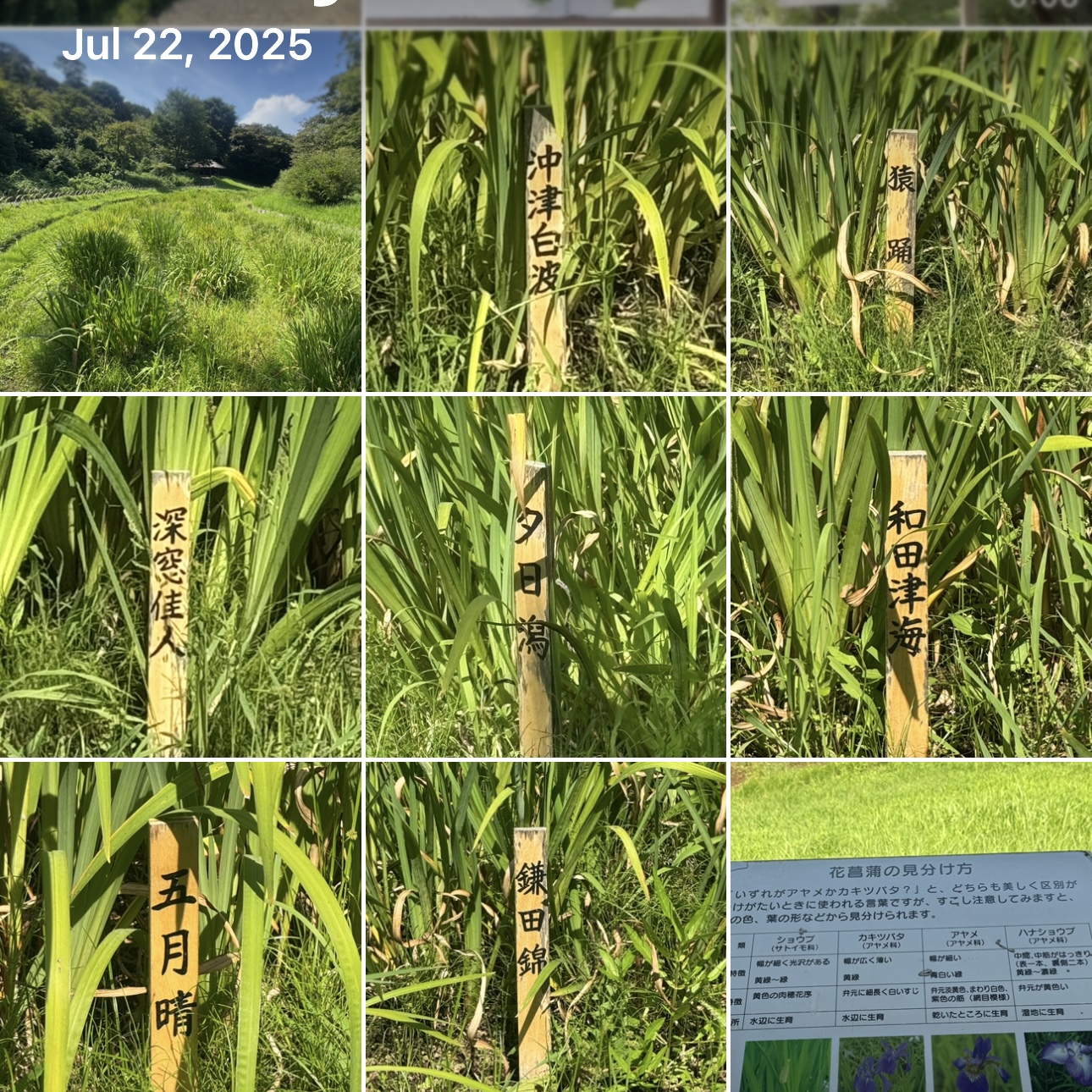
(Names of various irises in the lush, leafy little garden.)
While passing by a large bush of after blooming season kerria in a corner of the Iris Garden, I recalled how I first learned what kerria flowers look like during the pandemic lockdown, and the places I’ve seen them: on the side of the entrance of corridor pavilion in Zigong Park, outside the Brandeis University campus in western Massachusetts, in front of the Wall of Love in the Jehan Rictus garden square in Montmartre, Paris, France, and the lyrics “Clusters of kerria, misty morning, quiet waterwheel huts” in the song of “Spring in the North”. “Flowers delight me like a virtual pen, repainting vividly the previous sightseeing of flowers in my memory and bringing joys back again.” Thinking of the longer adjectives that will be associated with this bush of kerria in front me: the kerria flowers by the Iris Garden, in the Meiji Jingu Inner Garden, in the Meiji Jingu Shrine, Tokyo, Japan, I can’t help but smile. The striking beauty of Kerria is unforgettable for flower lovers, as I still remember the large bush of blooming kerria flowers I saw in Zigong Park in my childhood. As a flower lover with good memory, I felt even in their off-blooming season, flowers can still delight me.
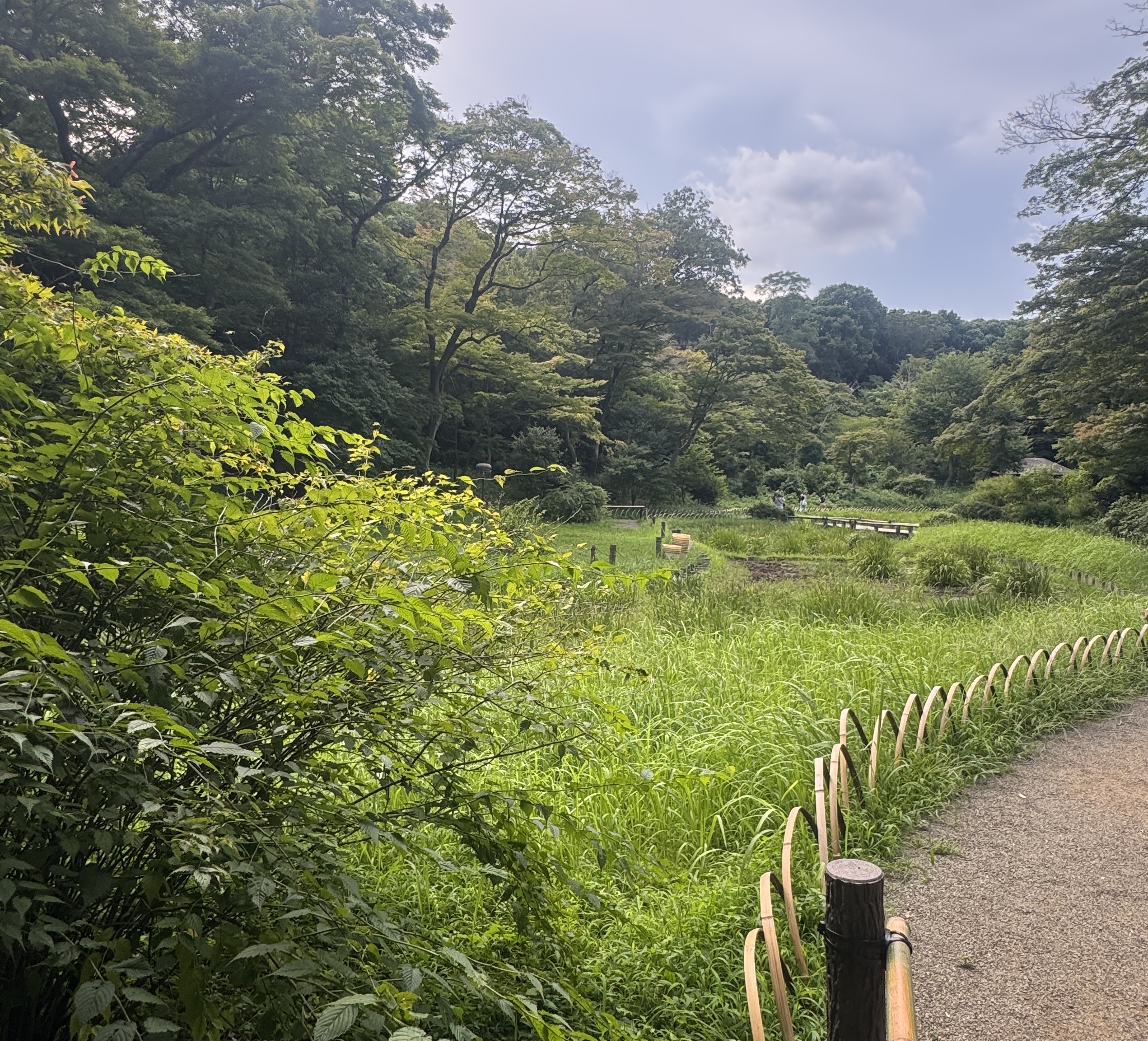
(A bush of kerria flowers, past their blooming season, next to the Iris Garden, in Tokyo July 22, 2025.)
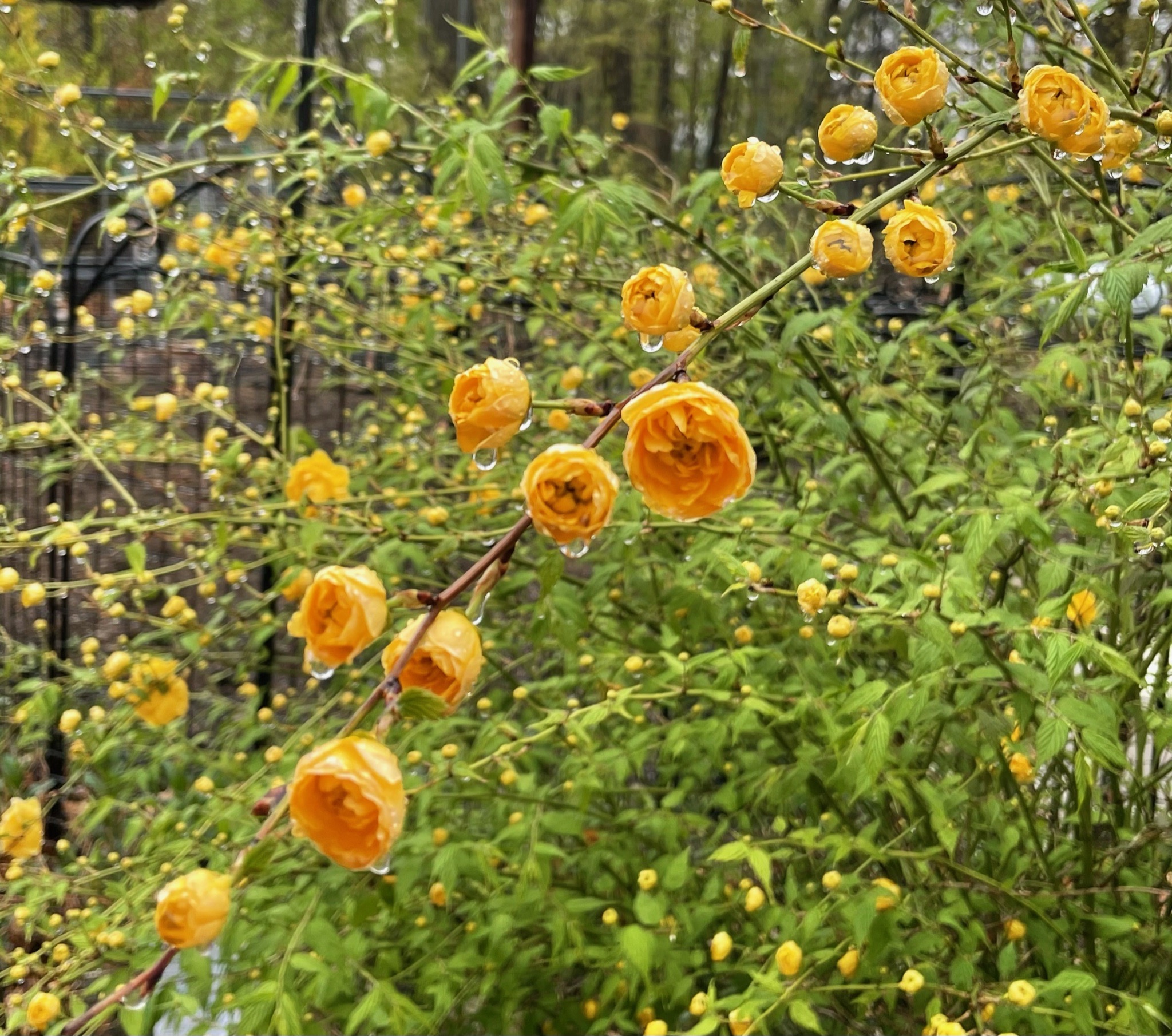
(Kerria flowers blooming in the rain outside the Brandeis University campus in western Massachusetts, April 29, 2021.)
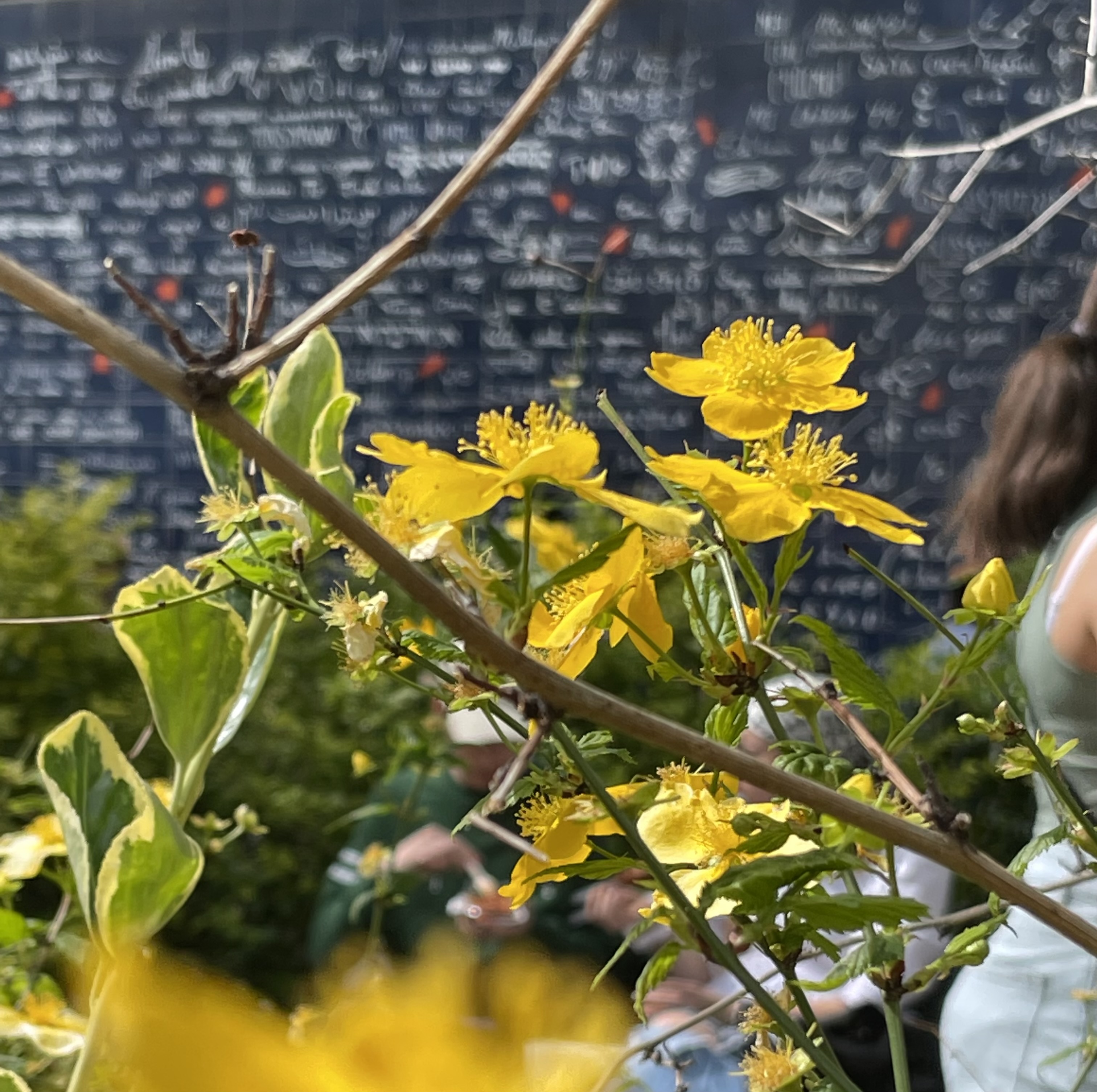
(Single-petaled kerria flowers in full bloom in front of the Wall of Love in Paris. 04-18-2022.)
There is a thatched pavilion high above the Iris Garden. Its thick thatch reminds me of the line “The triple thatch on my roof blew away” from Du Fu’s “Song of the Thatched Cottage Destroyed by the Autumn Wind.” I suspected this pavilion might bear traces of Du Fu, as his poem “The country is broken, but the mountains and rivers remain…” is often found in Japanese junior high school language textbooks.
The Inner Garden has few buildings, but abundant flowers, trees, and mosquitoes. The interplay of cicada and bird calls creates a low-key, natural beauty. I read in the tourist brochure that Emperor Meiji admired this place so much that he wrote a poem praising it which reads: “Deep in the woodland of Yoyogi, the quietude creates an illusion of seclusion from the city.” 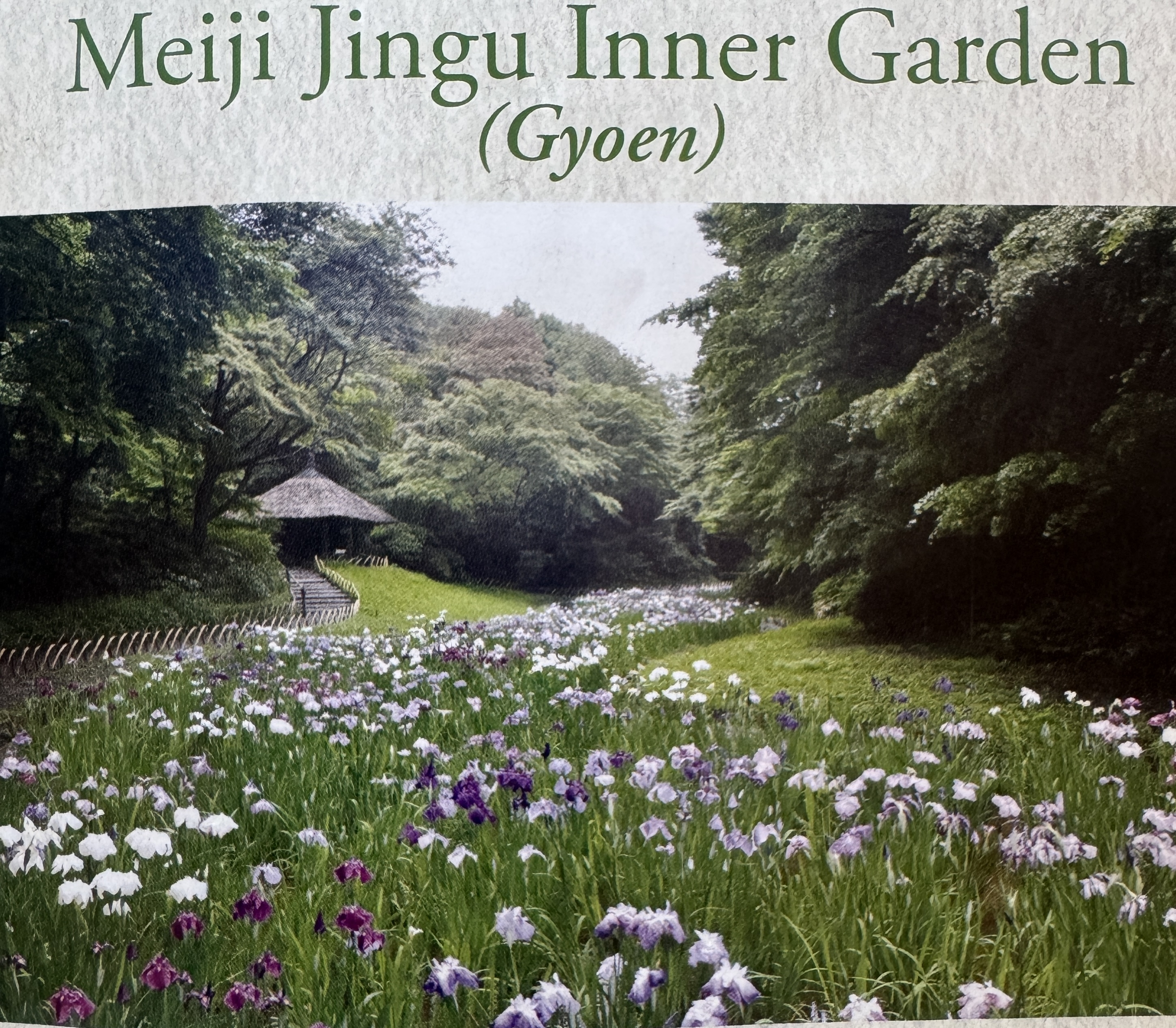
(The cover of a brochure of Meiji Jingu Inner Garen: the iris garden in bloom, a thatched pavilion, and lush trees.)
Kiyomasa Well
Because I wasn’t in a hurry, I wondered around the Iris Garden for a long time before heading to Kiyomasa Well which provides a constant source of water year-round for the irises who thrive in a moist environment. While lingering by the well, I bumped into a Japanese family of four: father, mother, and two school-age daughters. I watched the couple kneeling down for a bow, then stood up and gently faned the air from the well onto their faces. Curiously, I asked the mother, “Why are you fanning like that?” She explained that they were absorbing the energy from the well, as the well is famous and has magical, and that by fanning the air towards us we can absorb its energy. I thanked her and imitated her, gently fanning the air from the well onto my face. She was delighted to see this, and we stood by the well and chatted for a while. The two daughters stood quietly next to her, her husband facing her nodding and acknowledging her occasionally. I felt it was a picture of family harmony. Hiromi Oguribayashi, unlike typical Japaneses ladies, is talkative, she wrote her name in Chinese for me and told me that she studied economics at a university in Tokyo, that her family flew here to visit Tokyo Disneyland (she told me where her home was, but I didn’t understand) and will fly back home tomorrow. She also said and that her daughters are 11 and 8. After they left, I stayed by the quiet well, continuing to appreciate its magic. Then a young couple came, and the boy skillfully bowed and gently fanned the air from the well onto his face with his hands. I felt that the sincere look on his young face added energy to Kiyomasa Well.
After leaving Kiyomasa Well, I followed the signs to the exit and sat on a stone bench under the shade of a tree on the top of the Iris Garden. Two girls passed by and asked, “Could we sit here for a while?” I quickly moved to one side of the bench and said, “Of course.” We sat on the same bench and chatted for a while. They were from the United States, third-year college students majoring in accounting. Wendy, who spoke Chinese, was born in the United States, she will stay in Japan for a month; Victoria, a tall Caucasian, will return to the US after a week in Japan. They were planning to leave after resting for a while. I asked if they had visited the Kiyomasa Well. They said no. I repeated Hiromi’s words: “Kiyomasa Well is famous and has magical. We can absorb its energy.” I enthusiastically demonstrated to them how to fan air from the well onto my face to absorb its energy. After hearing my introduction, they stood up and walked towards the well. I was happy to put my newly-acquired knowledge into practice as a tour guide for people who had come from afar. Of course, I knew that Kiyomasa Well might not have magical powers. I remembered what the priest said to Eileen in the movie “Miracle Club” which I had just watch during my flight: “The real purpose of the pilgrimage was to sustain one’s faith even in the absence of miracles.” I felt that what I saw and did at Kiyomasa Well was a reflection of the priest’s words. The Kiyomasa Well may not has magical, but Hiromi’s family, the young boy, and I all felt its magical energy at the well. I also passed this magic on to the two American girls. The magic is human love.
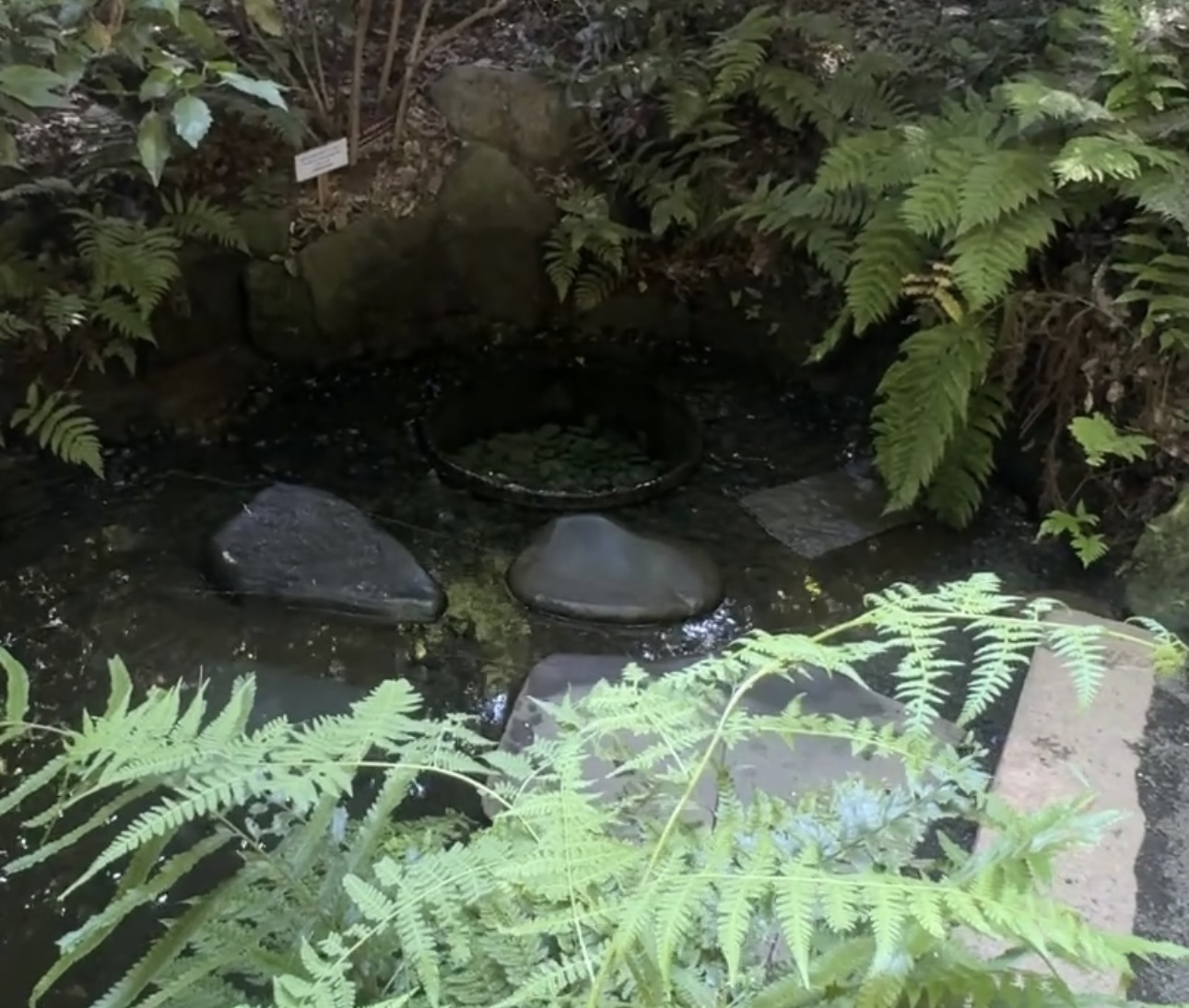
(The isolated and tranquil Kiyomasa Well.)
Visiting Tokyo’s Iris Garden, I once again experienced the feeling of “following my interests, obeying my physical strength, exploring foreign lands, and being enchanted by all the beauty, it’s like a dream come true.” How wonderful!
